Opinions and observations expressed on this blog reflect the authors' individual experiences and should not be construed to be financial advice. None of the members of this blog are licensed financial advisors. Please consult your own licensed financial advisor if you wish to act on any recommendations here.
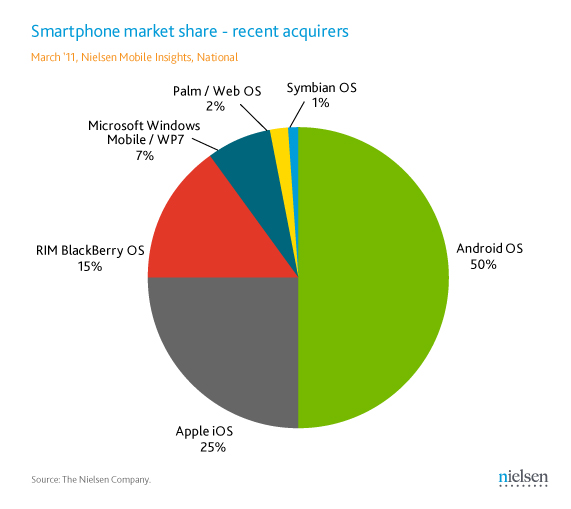
Google's edge appears to be growing, for the moment at least. Among recent acquirers, it is toasting just about everyone else:
These data confirm why Motorola Mobility (MMI) reported a solid first quarter while Research in Motion (RIMM) reported a positively dreadful quarter. Incidentally, the trends in both stocks going into their earnings releases were indicative of exactly the opposite of what was reported. RIMM had been having a small rally while MMI had been slumping into its release. So much for the market always predicting these things correctly.
On a larger point, it is very difficult to see how RIMM recovers from its rapidly shrinking share. Both Android and iOS have been making headway in being adopted by enterprise customers, which are RIMM's last bastion. To put it mildly, I wouldn't be astonished if RIMM is struggling for survival in another five years.
These data are not too bearish for Apple (AAPL) at the moment because 25% of a growing pie is not all that bad, though this isn't as bullish for them as it once was. Still, this share relatively to where they had been is a much better position than RIMM, which once had something over 50% market share and now is only at 15% among new adopters.
Generally, it would be fair to say that Android is doing well as a collective enterprise, but two articles put together make one realize what the challenges are for those attempting to make some money on the rise of the smartphone OS.
Reading the first article, you would say, "Motorola has two of the top five selling phones. They must be doing well." and reading the second you would say "...What gives?" I that that this highlights a problem for the Android phone makers in that the OS itself is prospering while the companies making the phones are not, or at least not as much as one would think.
Despite shrill articles such as this one from Bloomberg, the market probably has the reaction just about right which is that none of the stocks in question moved a whole lot on this announcement. Apple (AAPL) ran up in the last couple of months in anticipation of this, but didn't do a whole lot today. Neither did Verizon (VZ), AT&T (T), Motorola (MMI) or anyone else for that matter. I think that's because frankly there isn't the iPhone frenzy there once was and that those with existing contracts won't be that willing, or able, to switch immediately.
The article's assertion that half of Verizon users will switch from Android to iPhone seems a little ridiculous. I think that this was a classic case of an analyst not knowing so they just made something up, and something not particularly plausible. The problem that iPhone has in the long run against Android is that the Android universe of phones offers customers features in whatever configuration they might want. Additionally, in terms of hardware capabilities, by the next iteration of iPhone Apple will have to be playing catch-up big time against the new vanguard of Android phones.
There will be switchers, sure, but I just don't get the sense that the bulk of Android users are just clamoring to switch. No doubt, many AT&T users will switch, but that's a different story.
Motorola (formerly MOT) split into two separate entities in a long-planned divestiture that was put off by the calamitous financial markets in 2008 and early 2009. The two new companies, Motorola Mobility (MMI) and Motorola Solutions (MSI) followed a fairly logical delineation where the cell phone and set-top boxes pieces will be with MMI and the enterprise and business equipment side including RFID scanners, emergency dispatch systems, and mobile radios will be with MSI.
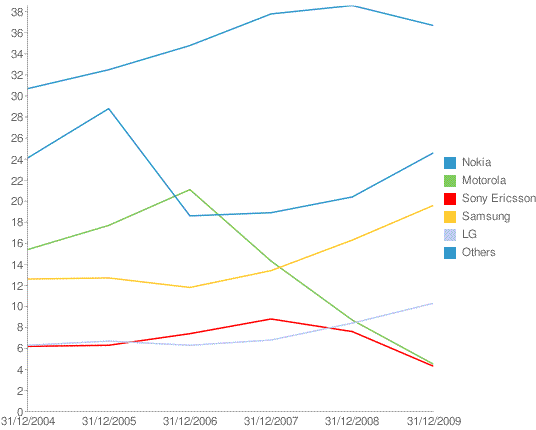
Interestingly, before Motorola became the champion of all things Android in the past 18 months or so, I would have said the MSI piece looked a whole lot better. Motorola's cell phone business was absolutely hemorrhaging market share to its various rivals to the point it was scraping along at about 5% as of the end of 2009 in the conventional cell phone business:
Credit goes to MobileMentalism.com
In 2009, sales in the mobile division were down a whopping 41% from a year earlier compared to 21% in their home network and set-top boxes segment and 13% in their enterprise segment. None of that was particularly much to celebrate, but business had clearly begun to stabilize in 2010 with third quarter results showing 20% sales growth in the mobile segment, 5% in the home segment and 9% in the enterprise segment.
Clearly, Android has good prospects going forward and Motorola's offerings in particular have a great deal to offer. I happen to have the original Droid myself so I am a little biased, but I'm a fairly big fan. Of course, Motorola's fortune's are not tied entirely to Android since other manufacturers, including HTC, can just take market share from Motorola and the others in the context of a growing Android pie. There's a good article in the Economist that expresses some skepticism on this point.
However, the profitability of the enterprise segment, which is now MSI, is on more solid footing at this point. The mobile division has been bleeding money, though at a slowing rate, for some time. With improved sales, that should reverse, but the current state of things is that the MSI segment is the more profitable one at the moment.
As a shareholder in Motorola, I now hold annoying amounts of both and have to decide what to do with the respective positions. When I originally bought Motorola, it was based on the idea that Android would help revive the fortunes of their cell phone division. This ended up not paying off as soon as I had hoped, but the indications are that they are really starting to hit their stride now. On this basis, I'll place the majority of my bets with MMI, though I have to round out the MSI position because it is a very irritating 12 shares right now. I like what I see in both segments, but I'll continue to bet on the Motorola mobile turnaround. In some ways, though, each is better than the other. In case you are wondering where I got that from, watch this trailer for a Fist Full of Dollars and For a Few Dollars More double feature: