Disclaimer

Opinions and observations expressed on this blog reflect the authors' individual experiences and should not be construed to be financial advice. None of the members of this blog are licensed financial advisors. Please consult your own licensed financial advisor if you wish to act on any recommendations here.
Showing posts with label Inflation. Show all posts

Tuesday, August 23, 2011

Why is there no hyperinflation?

Okay, we've had warnings ever since early 2009 about the prospect of a breakout of massive inflation due to a massive increase in the monetary base.  The logic, such as it is, goes something along the lines of:

1. Monetary velocity is a constant
2. The Fed has increased the monetary base substantially
3. Nominal GDP will rise substantially, but real GDP won't
4. The difference will be taken out on us in inflation

If you believe the first step of this sequence, that all follows.  If you double the amount of money in the system and everyone still does everything in the same way, meaning consumption patterns in terms of unit quantities don't change and production also does not, prices should approximately double.  However, the way money is "made", through bank lending, has been a broken mechanism as the demand for credit is very weak.

So, as the Fed has dramatically increased money supply, nothing much has happened.  All that has happened is that monetary velocity has collapsed (left scale is velocity, right scale is monetary base in billions):


Velocity is about a third of what it was during the period just preceding the crisis while the monetary base has approximately tripled.  With the banking sector still sick and consumers still deleveraging, this situation will not change soon.  A strong increase in money supply is a necessary (in most cases), but clearly not a sufficient ingredient for inflation.

Saturday, April 30, 2011

Inflation Outbreak Not Likely

Of course, this is news to someone who drives a car, but the food and energy spikes of late are the consequence of either long term supply issues or short term disruptions. Both require more discussion than I care to go into right now. However, is there generalized inflation? No.

Case in point:


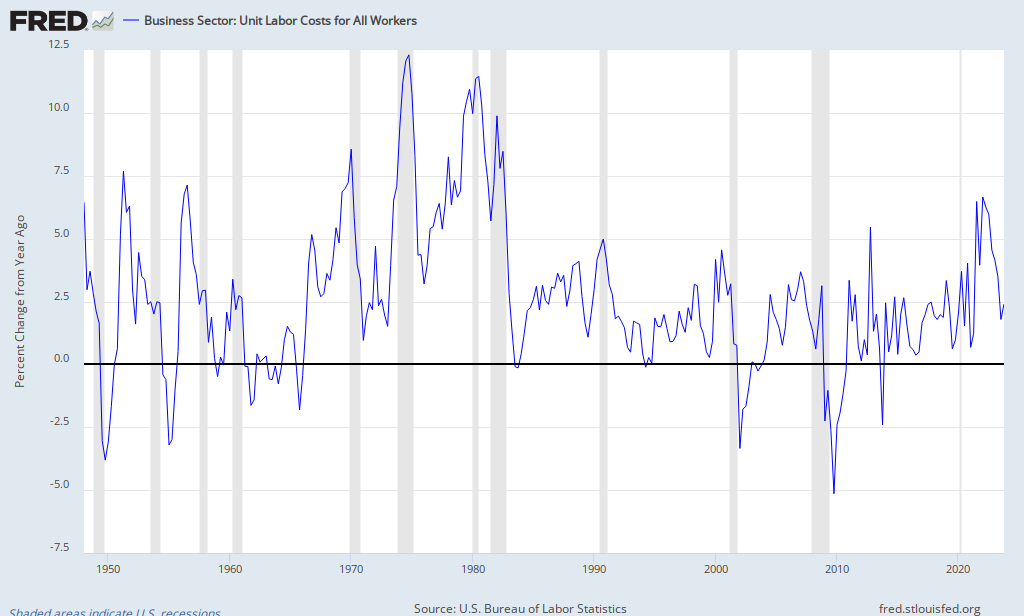
If you click on this graph of unit labor costs from the St. Louis Fed, you will see that we are in a very benign stage of labor cost growth. Benign is actually mild since we are only just now approaching the flat line on a year on year basis. Compare this to the 1970s or even the late 1960s. There is just about no resemblance.

Of course, the lack of wage inflation makes these energy and food price spikes just that much more damaging as those are coming right out of people's real incomes.

Thursday, December 2, 2010

Stocks and Inflation

Just a real quick point about stocks and inflation because I saw an article yesterday about how you don't want to own stocks during periods of high inflation.

First off, inflation still is not anywhere on the horizon. Until there is wage inflation, there can't be any real outbreak of inflation. Anything else that occurs will be transitory. Second, stocks are priced in nominal dollars because their earnings are based on nominal dollars. This means that, all other things being constant, stocks should actually rise as a result of inflation in the long run. However, because all things are not constant, interest rates rise in the short run, which compresses the multiple that stocks can command. This is what happened during the 1970s. Corporate earnings grew quite a bit, actually, but interest rates nearly tripled during the decade.

Once the inflation subsides and interest rates drop, stocks' multiples expand on a larger earnings base. This is, to a large extent, why the 1980s were so good for stocks, particularly in the first two years of the rally. Stocks had gotten ridiculously cheap and the decline in interest rates starting in 1982 helped to provide for a robust multiple expansion.

The upshot of this is that in the long run, stocks are as much an inflation hedge as any other asset can possibly be. In the short run, however, they can take a hit due to interest rate surges. Still, this is purely an academic discussion since inflation is not a threat. Incidentally, yes, deflation is uniformly bad for stock prices.

Saturday, November 27, 2010

Quantitative Easing Explained.... By Sane People


This isn't as silly as the much more popular version that was made by Austrian (school) economists/Tea Party/etc idiots, but it is fundamentally much more correct.

Monday, October 25, 2010

El-Erian Says Quantitative Easing Will Cause Inflation

http://www.bloomberg.com/news/2010-10-25/pimco-s-el-erian-says-fed-treasury-purchases-may-disappoint.html

I say "Good". Inflation is necessary to unwind some of the excesses of the credit bubble over the past decade. Debt is denominated in nominal dollars and can be eroded via inflation. Particularly, inflation would help unwind the negative equity situation that many homeowners find themselves in.


Now, of course the flip-side is that this means higher interest rates and the plethora of issues that come with that. However, I think we have proven since mid-2008 that low inflation and low interest rates are not enough particularly in an environment of high consumer debt loads. The issue is if we get the sort of inflation we had in mid-2008 when commodity prices surged and had the effect of rapidly reducing real incomes. That makes servicing debt actually more difficult. To be honest, given the behavior of commodities markets so far, I am concerned about this prospect. It does seem that the excess liquidity likes to slosh in there at the moment (See the commodity charts below).


Friday, October 15, 2010

Oh those inflation hawks...

0.1% headline CPI and 0.0% core: http://www.bls.gov/news.release/cpi.nr0.htm

Yep, that inflation's out of control...