Gallup polls on a number of kind of, well, random sentiments. Among them is this poll on whether or not people would categorize themselves as "energized" or "ailing". Frankly, I'm amazed that 30-40 percent of people always consider themselves to be "ailing", but more peculiar than that is the constant back and forth chop in the numbers. Given that these changes reflect net rather than gross changes in each category, I'm amazed that as much of the population swings back and forth as it does.
http://www.gallup.com/poll/110128/Gallup-Daily-Health.aspx
I would be curious to see, all other factors being held constant, if you line up these numbers with stock market performance on a day to day basis if there would be any relationship.
Sunday, April 17, 2011

Tuesday, April 12, 2011
Is the Ryan Plan a Serious Budget Proposal?
I will give credit where credit is due in the Paul Ryan did lay out a proposal that does indeed tackle, whether one agrees with it or not, the problem of runaway Medicare spending. Eventually, Medicare, as well as Medicaid, will render the federal budget unable to be balanced. However, the revenue side of the proposal is horridly lacking. Simply waving your hand about the amount of revenue that will be collected is a nice trick, but hardly one meriting serious attention. My short answer to the title of the post would be "No.".
Bruce Bartlett has some good thoughts on it as well.
I'm not sure that Obama's budget proposals will be any more serious in terms of actually truly proposing the changes of the magnitude that need to occur in order to balance the budget, but then again I am not entirely convinced that the budget needs balancing at this particular point. I'm reasonably convinced that the President will propose possibly a more balanced set of proposals, more along the lines of a "shared sacrifice", but my guess is that they will still be half-measures.
Bruce Bartlett has some good thoughts on it as well.
I'm not sure that Obama's budget proposals will be any more serious in terms of actually truly proposing the changes of the magnitude that need to occur in order to balance the budget, but then again I am not entirely convinced that the budget needs balancing at this particular point. I'm reasonably convinced that the President will propose possibly a more balanced set of proposals, more along the lines of a "shared sacrifice", but my guess is that they will still be half-measures.
Monday, April 11, 2011
Sotheby's: A Promising Listing?
Normally, I don't like momentum plays, but at this particular time Sotheby's (BID) may have a little extra bid action (yes, that was intentional) left in it as long as alternative assets remain in play as they are.
Essentially, there are two major trends going in their favor. One is that very rich people always get it in their head during the course of an economic cycle that they need to expand beyond conventional financial markets into the unusual. In this economic cycle, it has happened unusually quickly. That is largely due to the second trend, which is that very rich people barely skipped a beat from the financial crisis and have rapidly rebuilt their vast sums of wealth and need avenues to fritter it away on.
I will caution, however, history is not a kind master to the long-term holder of Sotheby's:

Essentially, there are two major trends going in their favor. One is that very rich people always get it in their head during the course of an economic cycle that they need to expand beyond conventional financial markets into the unusual. In this economic cycle, it has happened unusually quickly. That is largely due to the second trend, which is that very rich people barely skipped a beat from the financial crisis and have rapidly rebuilt their vast sums of wealth and need avenues to fritter it away on.
I will caution, however, history is not a kind master to the long-term holder of Sotheby's:

You will note that it always seem to peak in anticipation of a recession, or at least major market downturn, by anywhere between six months and a year, but never much before that. Each of its major three peaks coincides with the peak of an economic expansion and each of its major troughs coincides with the trough of the general economy (or at least the financial markets). It's essentially a supercharged coincident play, equivalent to the double or triple long ETFs for the general market. The question is, how much will the bids rise?
In this case, I don't feel that we are yet at the end of the most recent economic expansion, though oil is certainly doing its damnedest to derail it. Furthermore, the status of the uber-rich is well secured by the global politics of the moment, perhaps with some emphasis on "of the moment".
One thing that does give me caution is that the collectibles market seemed to kick in much earlier in this economic cycle than it tends to. After the last bear market it took Sotheby's seven years to reclaim its old high. This time, it looks like it will do it in little more than two.
The thing to keep in mind if you play Sotheby's is that, like the goods it creates a market for, to bottom can fall out of its price awfully quickly. If you make a lot of money on Sotheby's, take it and go.
Cost Basis and Dividend Reinvestments
So, I finished up my taxes yesterday, but had to contend with these annoying drips and drabs of stocks I had liquidated last year. Specifically, I had anywhere between 0.1 shares and 0.54 shares of a variety of stocks that I had sold long ago. The reason was that I had reinvested dividends and accumulated fractional shares in my brokerage account.
Let me tell you that calculating the cost basis on these things was annoying and took far longer than it should have. With a few of them, I just took a zero cost basis, meaning that rather than just the capital gain being taxed, the whole thing was taxed because it wasn't worth my time to figure it out. Sure, it cost me a little bit of money, but I figure the government might be able to make use of my charity these days.
Let me tell you that calculating the cost basis on these things was annoying and took far longer than it should have. With a few of them, I just took a zero cost basis, meaning that rather than just the capital gain being taxed, the whole thing was taxed because it wasn't worth my time to figure it out. Sure, it cost me a little bit of money, but I figure the government might be able to make use of my charity these days.
Sunday, April 10, 2011
Steel Stocks a Steal?
While I was on vacation I got a chance to watch some of the talking heads on CNBC and Bloomberg explain which scheme they were pushing on investors lately. The one that I heard more than once was that the steel sector has been lagging and is particularly undervalued given the global economic recovery.
It doesn't matter what you look at, unless the company has a business outside of purely steel. It can be Gerdau (GGB) from Brazil, Arcelor Mittal (MT) from India, US Steel from America (X), or whatever else you examine. They have all trailed the market by a wide margin over the past year. Large excess capacity has kept steel prices from rising even with sharp increases in world industrial production. When you are in a commodities business and you don't have pricing power, things can get ugly. How ugly?

Well, if you bought these three, you have badly trailed the markets. What's more is that even with rising industrial production and construction spending, at least worldwide, prices are unlikely to recover anytime soon.
That's not to say that it isn't worth watching these three and the steel sector in general. At some point, that sector will turn up. It just may not be imminent. Until U.S. non-residential construction begins to pick up and auto sales really catch fire, this excess capacity will not likely be worn down.
It doesn't matter what you look at, unless the company has a business outside of purely steel. It can be Gerdau (GGB) from Brazil, Arcelor Mittal (MT) from India, US Steel from America (X), or whatever else you examine. They have all trailed the market by a wide margin over the past year. Large excess capacity has kept steel prices from rising even with sharp increases in world industrial production. When you are in a commodities business and you don't have pricing power, things can get ugly. How ugly?

Well, if you bought these three, you have badly trailed the markets. What's more is that even with rising industrial production and construction spending, at least worldwide, prices are unlikely to recover anytime soon.
That's not to say that it isn't worth watching these three and the steel sector in general. At some point, that sector will turn up. It just may not be imminent. Until U.S. non-residential construction begins to pick up and auto sales really catch fire, this excess capacity will not likely be worn down.
Does China's First Quarter Trade Deficit Mean Anything?
http://www.marketwatch.com/story/china-hits-first-quarterly-trade-deficit-since-04-2011-04-10
The short answer here is that it is too soon to tell. You'll notice that it was the first trade deficit since 2004, which was when China's trade surpluses really began to take off, reaching stratospheric levels in 2007 and 2008. China's first quarter trade numbers are always a little weird due to the strong seasonal effects of the Chinese New Year, but most of all the problem is likely tied to the deteriorating terms of trade that China faces due to skyrocketing commodity prices while consumer and industrial demand for Chinese products elsewhere in the world isn't growing that fast.
As to whether even a persistent trade deficit would mean anything for China, that's not clear either. Trade deficits can be problematic for countries with fixed currencies, but we are a long way off from a point of a balance of payments crisis in China. As a matter of fact, we are so far off from that that I feel bad for even including those words in the same sentence.
China's more serious problem has to do with its very sick real estate markets that are flooded with too much liquidity, too much supply, and prices that don't reflect reality.
The short answer here is that it is too soon to tell. You'll notice that it was the first trade deficit since 2004, which was when China's trade surpluses really began to take off, reaching stratospheric levels in 2007 and 2008. China's first quarter trade numbers are always a little weird due to the strong seasonal effects of the Chinese New Year, but most of all the problem is likely tied to the deteriorating terms of trade that China faces due to skyrocketing commodity prices while consumer and industrial demand for Chinese products elsewhere in the world isn't growing that fast.
As to whether even a persistent trade deficit would mean anything for China, that's not clear either. Trade deficits can be problematic for countries with fixed currencies, but we are a long way off from a point of a balance of payments crisis in China. As a matter of fact, we are so far off from that that I feel bad for even including those words in the same sentence.
China's more serious problem has to do with its very sick real estate markets that are flooded with too much liquidity, too much supply, and prices that don't reflect reality.
Wednesday, April 6, 2011
Wasn't that timely? (CSCO)
On March 26th, I posted on the continuing woes of Cisco (CSCO).
Today, they announce that there will be major overhauls at the company, including a rumored divestiture of its consumer business (Linksys). http://www.cnbc.com/id/42462858
I'm fairly skeptical at this point. Cisco has not been able to string together two good years in the last decade. That's not to say you can't make money on it from time to time. Just because a company has no long term growth trend doesn't mean that there isn't any profit potential for traders. Just be wary of a long-term holding. Given its current price, it's possible that there may be the third Cisco renaissance in a decade, but I'm still not sold on the long-term. If there was a complete management overhaul, maybe I would feel better.
Today, they announce that there will be major overhauls at the company, including a rumored divestiture of its consumer business (Linksys). http://www.cnbc.com/id/42462858
I'm fairly skeptical at this point. Cisco has not been able to string together two good years in the last decade. That's not to say you can't make money on it from time to time. Just because a company has no long term growth trend doesn't mean that there isn't any profit potential for traders. Just be wary of a long-term holding. Given its current price, it's possible that there may be the third Cisco renaissance in a decade, but I'm still not sold on the long-term. If there was a complete management overhaul, maybe I would feel better.
Brazil = China? Well, EWZ = FXI
I was browsing the emerging market ETFs and, before I made an explicit comparison between the iShares Brazil ETF (EWZ) and the iShares China ETF (FXI), I said to myself "That chart looks awfully familiar...".
There is a reason for that:

There is a reason for that:

They trade nearly identically. I remember once preferring Brazil over China, and most of the time that has made sense. Brazil's markets have vastly outperformed China's since 2004. However, it appears that since the huge 2008 correction in all emerging market stocks (and all stocks for that matter) these two markets have been locked in a very tight dance. I know that the Brazilian exports to China are one of the primary drivers of economic growth in Brazil, but you would think that differentials in company performance would produce more variance than this.
Calculated Risk: Nominal House Prices May Bottom This Year
Bill McBride at Calculated Risk has made a prediction of house prices, at least in nominal terms, bottoming out this year. I have to agree for a number of reasons that he has enumerated. Price to rent ratios, typically one of the best indicators of the relative valuation of housing, have normalized to the extent that much of a further decline is very unlikely.
This is not to say that housing is a particularly good investment relative to other assets. History teaches us that recoveries from real estate crashes, whether they be Japan in 1990, select U.S. markets in the early 1990s, Hong Kong in 1997, or any number of U.S. markets in the early and mid-1980s, are very slow and painful before they start gaining momentum. As such, expecting any large bounce back in the intermediate term is not a good idea. House prices have declined to reasonable levels rather than undervalued levels.
This is not to say that housing is a particularly good investment relative to other assets. History teaches us that recoveries from real estate crashes, whether they be Japan in 1990, select U.S. markets in the early 1990s, Hong Kong in 1997, or any number of U.S. markets in the early and mid-1980s, are very slow and painful before they start gaining momentum. As such, expecting any large bounce back in the intermediate term is not a good idea. House prices have declined to reasonable levels rather than undervalued levels.
Saturday, April 2, 2011
Do Not Buy Coins to Accumulate Precious Metals
Frankly, I'm not a big fan of buying precious metals in any form. I can justify maybe 5% of one's portfolio being invested in commodities generally, and only a portion of that being invested in precious metals. The pricing is too arbitrary to be much larger than that, but some presence probably provides additional stability to your portfolio. However, there is the right way to do it and the wrong way to do it.
As someone who collects coins, you might expect that I would endorse this as a way to accumulate gold and silver. Nothing could be further from the truth. It is precisely because I am familiar with this market that I can tell you that you should not do this.
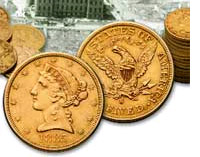
Now, you will see infomercials selling a lot of this:
 They will emphasize it as good method to accumulate "real, physical gold you can hold in your hand". Similarly, E-Bay auctioneers will make the same pitch, and possibly pitch the historical and collectible value of the gold coin as an added extra. The difficulty is how terribly inefficient and finicky the collectible coin market is.
Case in point, is the 1909 gold Double Eagle with a Denver mint mark. If I've already lost you, you have proven my point already and you don't need to go any further. The value of this coin, with old gold values as of 2007 so you have to inflate these values, could vary between $1,850 if it was a MS-60 grade and $8,000 if it was a MS-63 grade. These grades can vary between coin rating agencies and there are a lot of phony agencies out there that provide inflated grades. If you buy at a premium grade that is incorrect, you can be getting yourself in a ton of trouble and you may already be out several grand without knowing it. Even reputable coin rating agencies like PCGS or NGC can be wrong, but you're safer if they've rated them. Generally, their word is... as good as gold. I hate myself for saying it, but there it is.
This brought up another point which is that someone selling you a collectible/historical coin may take advantage of your ignorance and not bother mentioning the mint mark. The mint mark is absolutely critical in the case of many coins as the total mintage at the various mints in this country and others varies widely as you might expect. Therefore, as a direct consequence, rarity is also highly variable. In the case of the coin mentioned above, a MS-63 1909 gold Double Eagle with a San Francisco mint mark is worth only around 12% of what the Denver mint mark is worth.
However, even assuming you are dealing with reputable dealers and not someone Glenn Beck pushed on you or some random E-Bay dealer that only has sold 6 items, you are essentially doubling down on alternative assets. You are subjecting yourself not only to the volatility of the price of gold and silver, but also to the trends in the collectibles market as a whole and specifically preferences regarding individual classes of coins. It may be that ten years from now, not only is gold down 40%, but that 1909 gold Double Eagles are out of favor in the collectibles market.
Coins that have little collectible value due to their commonality are actually better plays than the rare ones as there is less of a risk that you are bumbling into something that you don't understand and their is less of a squishy "collectible premium". However, the best bet is to buy gold/silver futures or just raw bullion if you want to make this play.
As for myself, I generally have stayed out of the high-ticket coins and have instead focused on coins that have interesting historical values to me. For example, getting the coin of a monarch in the last year of their reign before a revolution or some other event. You can actually get this reasonably cheaply if they are silver and they make for neat additions to any collection.
As someone who collects coins, you might expect that I would endorse this as a way to accumulate gold and silver. Nothing could be further from the truth. It is precisely because I am familiar with this market that I can tell you that you should not do this.
Now, you will see infomercials selling a lot of this:
Case in point, is the 1909 gold Double Eagle with a Denver mint mark. If I've already lost you, you have proven my point already and you don't need to go any further. The value of this coin, with old gold values as of 2007 so you have to inflate these values, could vary between $1,850 if it was a MS-60 grade and $8,000 if it was a MS-63 grade. These grades can vary between coin rating agencies and there are a lot of phony agencies out there that provide inflated grades. If you buy at a premium grade that is incorrect, you can be getting yourself in a ton of trouble and you may already be out several grand without knowing it. Even reputable coin rating agencies like PCGS or NGC can be wrong, but you're safer if they've rated them. Generally, their word is... as good as gold. I hate myself for saying it, but there it is.
This brought up another point which is that someone selling you a collectible/historical coin may take advantage of your ignorance and not bother mentioning the mint mark. The mint mark is absolutely critical in the case of many coins as the total mintage at the various mints in this country and others varies widely as you might expect. Therefore, as a direct consequence, rarity is also highly variable. In the case of the coin mentioned above, a MS-63 1909 gold Double Eagle with a San Francisco mint mark is worth only around 12% of what the Denver mint mark is worth.
However, even assuming you are dealing with reputable dealers and not someone Glenn Beck pushed on you or some random E-Bay dealer that only has sold 6 items, you are essentially doubling down on alternative assets. You are subjecting yourself not only to the volatility of the price of gold and silver, but also to the trends in the collectibles market as a whole and specifically preferences regarding individual classes of coins. It may be that ten years from now, not only is gold down 40%, but that 1909 gold Double Eagles are out of favor in the collectibles market.
Coins that have little collectible value due to their commonality are actually better plays than the rare ones as there is less of a risk that you are bumbling into something that you don't understand and their is less of a squishy "collectible premium". However, the best bet is to buy gold/silver futures or just raw bullion if you want to make this play.
As for myself, I generally have stayed out of the high-ticket coins and have instead focused on coins that have interesting historical values to me. For example, getting the coin of a monarch in the last year of their reign before a revolution or some other event. You can actually get this reasonably cheaply if they are silver and they make for neat additions to any collection.
Subscribe to:
Posts (Atom)